
Monday, April 12, 2010
Settling In


Monday, March 29, 2010
Weigh Day, Weigh Day
Every couple of months we have to return to the scales, take a deep breath, look down, and get real. It's time to cut back the two treats we love most in San Francisco: crusty artisan bread and Napa Valley wine. Besides the scales, there are other reminders. Like the full length mirrors in yoga class, or the jeans that, after all this time, must have been dried too hot.
 Our neighborhood is full of ethnic and eclectic treats. John Campbell's Irish Bakery has hot cross buns during Lent, and Irish brown bread and blueberry scones all year round. Across the street is the Russian Bakery, with huge anise-flavored cookies and mounded meringues in pastel colors, so large they look like a pink, yellow, and white mountain range in the window. The folded meat pies are hamburger-onion delicious in the same way as White Castles. Enjoy now, be sorry later.
There's Starbuck's banana bread, and Pete's coffee with biscotto for the dipping. Royal Ground boasts a glass case with full-blown desserts: chocolate cheesecake, red velvet layers, and pumpkin pie with a whipped cream option. The only guilt-free treat is at Java Beach, an internet coffee-shop where Judah St. meets the sea. Their grainy bran muffins are the size of a cantaloupe and the perfect accompaniment is a steaming cup of chai. Calories, yes. But to deserve this snack you must hike down through the park to 49th Avenue, along Speedway Meadow, past the buffalo range, Spreckles Lake, and the Angler's Lodge. Then skirt the ocean for a couple of blocks to the outdoor tables at Java Beach. You'll burn off the calories on the walk back home. Or at least that's what you say.
____________
photo: panini and tomato bisque soup from a restaurant in the Marina
 Our neighborhood is full of ethnic and eclectic treats. John Campbell's Irish Bakery has hot cross buns during Lent, and Irish brown bread and blueberry scones all year round. Across the street is the Russian Bakery, with huge anise-flavored cookies and mounded meringues in pastel colors, so large they look like a pink, yellow, and white mountain range in the window. The folded meat pies are hamburger-onion delicious in the same way as White Castles. Enjoy now, be sorry later.
There's Starbuck's banana bread, and Pete's coffee with biscotto for the dipping. Royal Ground boasts a glass case with full-blown desserts: chocolate cheesecake, red velvet layers, and pumpkin pie with a whipped cream option. The only guilt-free treat is at Java Beach, an internet coffee-shop where Judah St. meets the sea. Their grainy bran muffins are the size of a cantaloupe and the perfect accompaniment is a steaming cup of chai. Calories, yes. But to deserve this snack you must hike down through the park to 49th Avenue, along Speedway Meadow, past the buffalo range, Spreckles Lake, and the Angler's Lodge. Then skirt the ocean for a couple of blocks to the outdoor tables at Java Beach. You'll burn off the calories on the walk back home. Or at least that's what you say.
____________
photo: panini and tomato bisque soup from a restaurant in the Marina
Saturday, March 13, 2010
Mixed Metaphors

Any joy I felt on this small island was erased at the sight of the cell blocks, two tiers of cages hardly large enough to hold the regulation cot, toilet, and bowl-sized sink.
The next day's journey was a hike through Muir Woods. If the cell blocks of Alcatraz suggested ultimate confinement, then this grand canyon of sequoias stood for unbridled freedom. At every side, lush ferns and mosses presided over rocky creeks. Above us, arms of the sequoias soared to touch a white-paper sky, barely acknowledging that they, like us, were rooted in the soil.
Thursday, March 4, 2010


Wednesday, February 17, 2010
Kohala Photo Ops
The upper point of the Big Island is called Kohala. It's a region we haven't seen at all, so on this last day in Hawai'i, we once again lace on the hiking sandals and head north. I've adjusted to the fact that The Big Island isn't all that big; the trip will take a few hours but not the entire day.
 Kohala is the oldest part of the island, and upturned a'a has changed into something resembling soil. The ocean is to our left and washboard roads lead to the water. Finally the highway dead-ends at a small settlement called Hawi. There's an ice cream shop and a dozen or so Galleries, or upscale muu muu shops. We have an expensive single dip of coffee ice cream with chocolate chips, sit in the shade and get one of the locals to snap our photo.
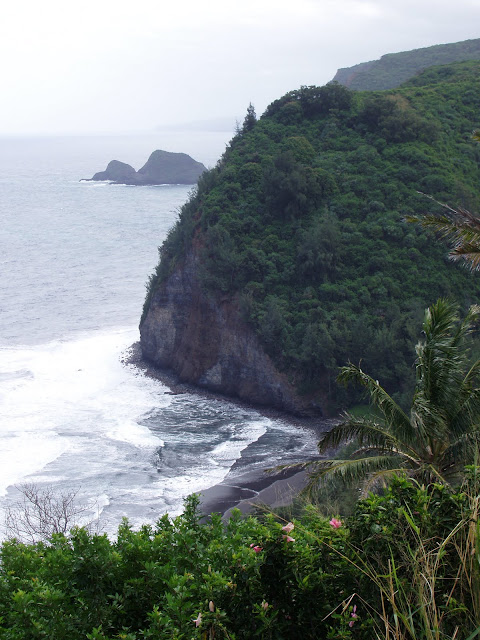
We shot way too many frames of this and even so didn't get a shot that does it justice. What's missing is a brooding sky to the east, a strong wind off the ocean, and the glaring face of the farmer whose fence row we were crowding.
After a salad and more last minute shopping back in Hawi, we headed down the center of the region, traveling the length of a volcanic spine that must have been slightly to the windward side. The hills were so lush we could have been in Ireland.


The road east from Hawi goes only one place, and that's to the Pululu overlook. The guide book said for the best photos, take the trail. There was no trail in sight, only many tourists who, like us, had inched their cars off the road for a better view.

We shot way too many frames of this and even so didn't get a shot that does it justice. What's missing is a brooding sky to the east, a strong wind off the ocean, and the glaring face of the farmer whose fence row we were crowding.
After a salad and more last minute shopping back in Hawi, we headed down the center of the region, traveling the length of a volcanic spine that must have been slightly to the windward side. The hills were so lush we could have been in Ireland.

Subscribe to:
Posts (Atom)
